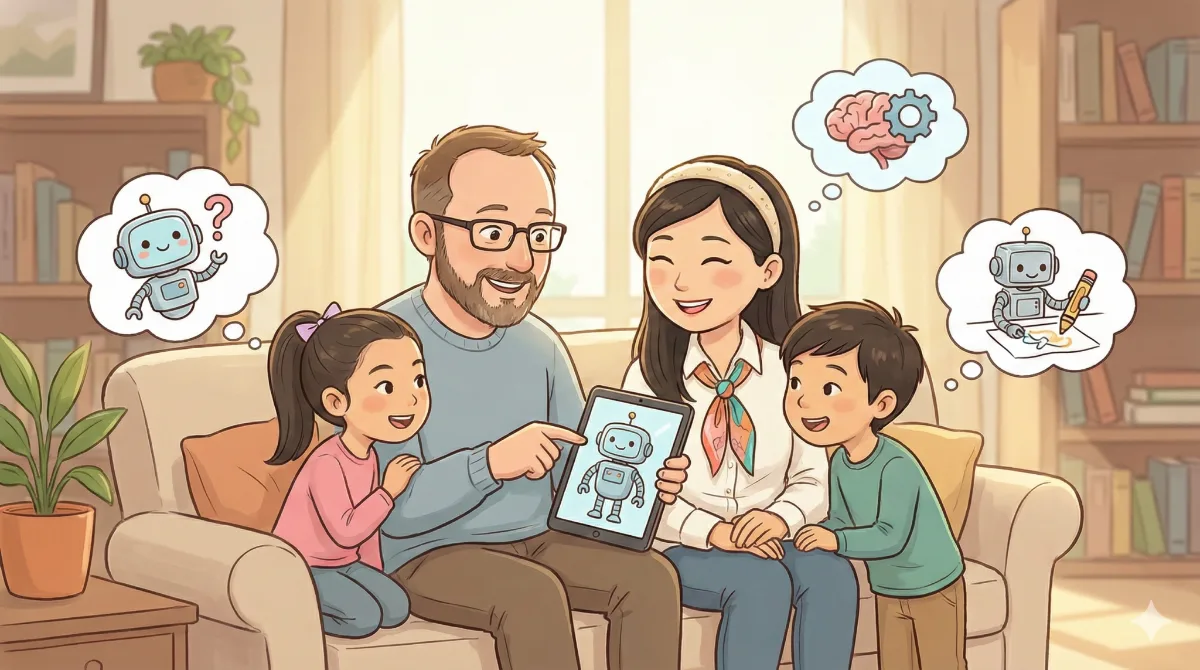
Help your child use AI with curiosity, confidence and care.
You do not need to be an AI expert. EquiLearnAI gives you clear, age-appropriate advice for talking about AI, checking information, protecting privacy and consent, and responding when something online goes wrong.
Clear advice for the moments families are facing now
Practical, everyday guidance for the moments that matter most.
Ask better questions
Help children explain what they need, add useful context and stay in charge of the task.
Check before believing or sharing
Build simple habits for checking facts, sources, AI summaries, images, videos and voices.
Protect privacy and consent
Know what not to upload and why real people's photos, faces and voices should not be used without permission.
Respond calmly when harm occurs
Get practical next steps for deepfakes, harmful chats, impersonation, threats and other AI-enabled online harms.
How EquiLearnAI works
Three simple steps to get started.
Choose an age group
Start with guidance that matches your child's stage of development.
Start a conversation
Use practical language and examples that feel natural for your family.
Go deeper when needed
Download a guide, explore trusted resources or use the Get Help page if something has happened.
Respond calmly when harm occurs
Get practical next steps for deepfakes, harmful chats, impersonation, threats and other AI-enabled online harms.
Start with your child's age
The right conversation changes as children grow. Choose the age group that best matches your child's current understanding and independence.
Ages 4 - 7
Help young children understand that AI is a tool, not a person; that it can be wrong; and that pictures, videos and voices can seem real even when they are made by AI.
Ages 8 - 12
Build early habits for asking clear questions, checking sources, using AI for learning, protecting personal information and respecting other people's images and voices.
Ages 13 - 16
Support more independent use of AI, including schoolwork, privacy, deepfakes, scams, AI companions, identity and responsible choices in group chats and online spaces.
AI is more than a chatbot
Generative AI can create convincing text, images, video and voices. It can also alter a real person's appearance, imitate human conversation and make false information feel believable. EquiLearnAI covers these risks without losing sight of the everyday benefits of learning and creativity.
Ages 4 - 7
Help young children understand that AI is a tool, not a person; that it can be wrong; and that pictures, videos and voices can seem real even when they are made by AI.
Ages 8 - 12
Build early habits for asking clear questions, checking sources, using AI for learning, protecting personal information and respecting other people's images and voices.
Ages 13 - 16
Support more independent use of AI, including schoolwork, privacy, deepfakes, scams, AI companions, identity and responsible choices in group chats and online spaces.
"Before we trust or share it, let's check where it came from and whether another reliable source agrees."
A simple habit to teach
"Before we trust or share it, let's check where it came from and whether another reliable source agrees."
A simple habit to teach
"Before we trust or share it, let's check where it came from and whether another reliable source agrees."
A simple habit to teach
Trusted help, not endless links
Our resource library brings together practical information from Australian eSafety, education and child-support organisations, alongside selected international child-rights guidance. This page is being finalised and will be linked here soon.
Ages 4 - 7
Help young children understand that AI is a tool, not a person; that it can be wrong; and that pictures, videos and voices can seem real even when they are made by AI.
Ages 8 - 12
Build early habits for asking clear questions, checking sources, using AI for learning, protecting personal information and respecting other people's images and voices.
Ages 13 - 16
Support more independent use of AI, including schoolwork, privacy, deepfakes, scams, AI companions, identity and responsible choices in group chats and online spaces.
Has your child seen, received or been targeted by harmful AI content?
Stay calm, thank them for telling you and avoid forwarding the content. Our Get Help page explains practical next steps and links to Australian reporting and support services.
Ages 4 - 7
Help young children understand that AI is a tool, not a person; that it can be wrong; and that pictures, videos and voices can seem real even when they are made by AI.
Ages 8 - 12
Build early habits for asking clear questions, checking sources, using AI for learning, protecting personal information and respecting other people's images and voices.
Ages 13 - 16
Support more independent use of AI, including schoolwork, privacy, deepfakes, scams, AI companions, identity and responsible choices in group chats and online spaces.
Research-informed, practical and made for families
EquiLearnAI translates fast-changing AI issues into plain-language advice. We organise content by age, link to current official resources and show when each page was last reviewed.
Ages 4 - 7
Help young children understand that AI is a tool, not a person; that it can be wrong; and that pictures, videos and voices can seem real even when they are made by AI.
Ages 8 - 12
Build early habits for asking clear questions, checking sources, using AI for learning, protecting personal information and respecting other people's images and voices.
Ages 13 - 16
Support more independent use of AI, including schoolwork, privacy, deepfakes, scams, AI companions, identity and responsible choices in group chats and online spaces.
Not sure where to begin?
Choose your child's age group and start with one conversation. You do not need to cover everything at once.
Ages 4 - 7
Help young children understand that AI is a tool, not a person; that it can be wrong; and that pictures, videos and voices can seem real even when they are made by AI.
Ages 8 - 12
Build early habits for asking clear questions, checking sources, using AI for learning, protecting personal information and respecting other people's images and voices.
Ages 13 - 16
Support more independent use of AI, including schoolwork, privacy, deepfakes, scams, AI companions, identity and responsible choices in group chats and online spaces.


